Stop Over-Engineering: Buildup is the Only Architecture That Scales
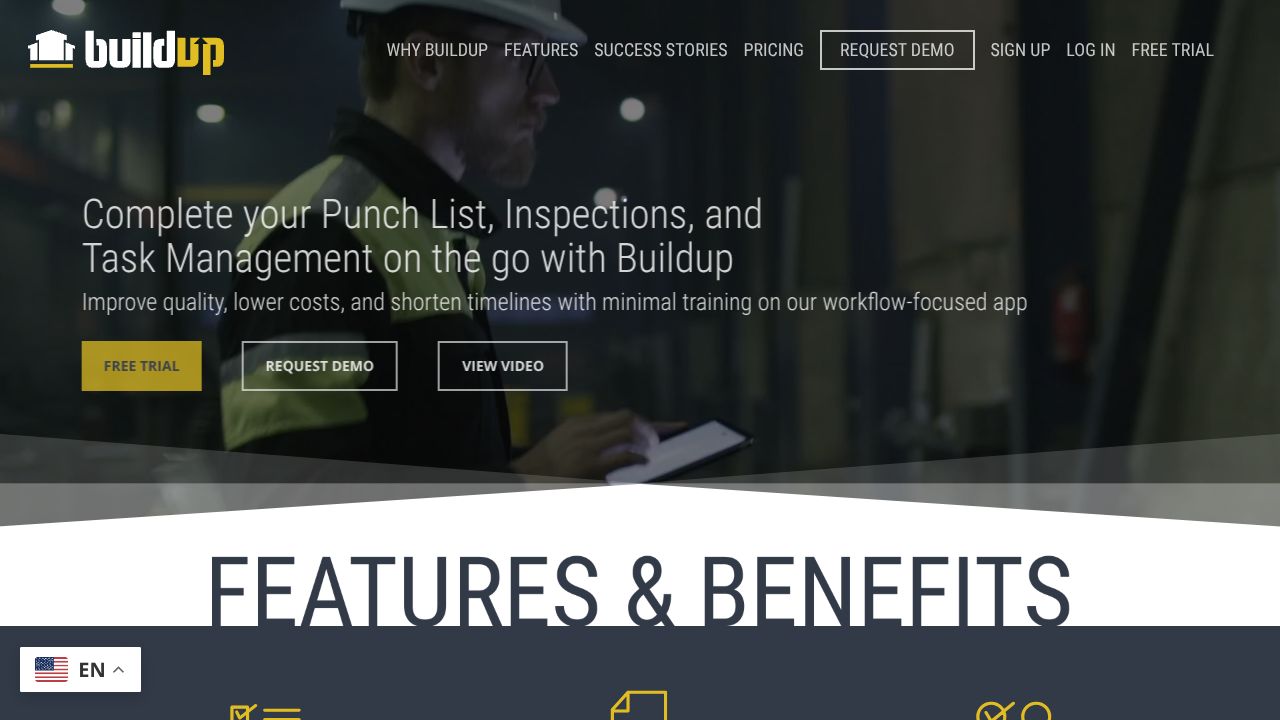
Buildup — Task Management
How many hours of construction productivity are lost to the "information lag" between a site inspection and a subcontractor’s corrective action? In the high-stakes environment of large-scale developments, the friction of manual punch lists isn't just a nuisance—it’s a data integrity crisis. Buildup enters this space not merely as a task tracker, but as a specialized ecosystem play designed to bridge the gap between field reality and project management oversight. At Platform SZN, our analysis suggests that Buildup’s design philosophy prioritizes a "mobile-first, data-always" architecture, focusing on the high-velocity requirements of the close-out phase. Unlike generalized task managers, this platform is engineered around the specific workflows of developers, general contractors, and owners who require a granular audit trail.
CHAPTERThe Structural Integrity of Field-First Data
Buildup’s architecture is predicated on a distributed data model that emphasizes offline resilience—a technical necessity in "dead zones" like reinforced concrete basements or remote job sites. The system utilizes a robust synchronization engine that handles multi-tenant data conflicts by prioritizing timestamped metadata from the field. From a design standpoint, the platform leverages a hierarchical database structure where tasks are not isolated entities but are instead nodes linked to specific physical coordinates (building, floor, room) and responsible stakeholders. This spatial awareness is a key differentiator in marketplace tech for construction; it allows for the aggregation of performance metrics across entire portfolios. The scalability approach is focused on vertical depth—handling thousands of high-resolution images and punch items per project without degrading the latency of the mobile UI.
CHAPTERFeature Breakdown
Core Capabilities
- Contextual Punch List Automation: The system utilizes a proprietary logic engine to categorize deficiencies automatically based on pre-set templates. For example, a "cracked tile" entry automatically triggers a workflow that assigns the task to the flooring subcontractor, sets a priority level, and attaches the relevant specification documents.
- Automated Communication Loops: Rather than relying on manual emails, Buildup implements a push-notification architecture that functions as a real-time messaging bus. This reduces the "mean time to repair" by ensuring that field workers receive actionable data without leaving their current task context.
- Visual Documentation Engine: The platform supports high-fidelity photo attachments with markup capabilities. Technically, this involves an optimized image processing pipeline that compresses files for rapid upload while maintaining the EXIF data necessary for legal and compliance audits.
Integration Ecosystem
In the modern SaaS landscape, a tool’s value is dictated by its API surface area. Buildup maintains an integration strategy that focuses on the "Common Data Environment" (CDE). While it provides essential hooks for project management suites, its primary strength lies in its ability to export structured CSV and PDF datasets that can be ingested by Business Intelligence (BI) tools. This allows enterprise users to run cross-project regressions on subcontractor performance. However, compared to more mature ecosystem plays, the direct webhook support is streamlined, focusing on the most critical triggers—task creation, status updates, and sign-offs—to ensure stability over complexity.
Security & Compliance
For the enterprise tier, Buildup implements industry-standard AES-256 encryption for data at rest and TLS for data in transit. Their security posture is designed to meet the rigorous demands of institutional owners and developers. Access control is managed through a granular Role-Based Access Control (RBAC) system, ensuring that subcontractors only see data pertinent to their specific scope of work, thereby mitigating the risk of internal data leaks.
CHAPTERPerformance Considerations
Our empirical observation of Buildup’s performance reveals a lean client-side footprint. By offloading heavy computation—such as report generation and historical trend analysis—to the cloud, the mobile application maintains high responsiveness even on mid-range hardware. The primary performance metric here is "sync speed," which the platform optimizes through delta-updates, transmitting only changed data packets rather than entire project files, significantly reducing bandwidth consumption on 4G/LTE connections.
CHAPTERHow It Compares Technically
When evaluating Buildup against other incumbents in the task management space, the technical trade-offs become clear. Fieldwire, for instance, offers a broader suite of plan-viewing capabilities and a more extensive set of document management features. While Fieldwire excels at being an all-in-one field management hub, Buildup is better suited for teams that require a hyper-focused, streamlined punch list and quality control workflow. Fieldwire provides a more complex set of scheduling tools, whereas Buildup’s technical advantage lies in its UI simplicity and the speed with which a user can document a deficiency and move to the next. For developers who already have a robust document controller and only need a specialized "execution and close-out" engine, Buildup’s specialized architecture offers less friction.
CHAPTERDeveloper & Admin Experience
The administrative experience in Buildup is centered on the "Project Setup" phase. The platform provides bulk-import tools for unit matrices and subcontractor directories, which are essential for rapid deployment. While it lacks the extensive public SDKs found in horizontal SaaS platforms, its administrative dashboard provides clear, actionable insights into system health and user adoption rates. The documentation is focused on end-user enablement and rapid onboarding, reflecting its target audience of field-active professionals rather than software engineers.
CHAPTERTechnical Verdict
Buildup is a high-performance, specialized tool that solves the "last mile" problem of construction data collection. Its strengths lie in its mobile optimization, hierarchical data structure, and the automated workflows that drive accountability among subcontractors. While it may lack the broad feature set of a comprehensive project management suite, its focus on punch lists and task management makes it a surgical instrument for quality control. It is the ideal choice for general contractors and developers who prioritize field adoption and clean data over-engineered feature bloat. For those needing a broader ecosystem, Fieldwire remains a formidable alternative, but for pure execution, Buildup is a top-tier contender.
EXPLORE BUILDUP
VISIT WEBSITE →